
Future Wallet (future-wallet.io) Review: Security Warnings, Crypto Risks, and Investor Concerns
If you are searching for a Future Wallet (future-wallet.io) review, there are serious reasons to avoid using the platform until its legitimacy can be independently established.
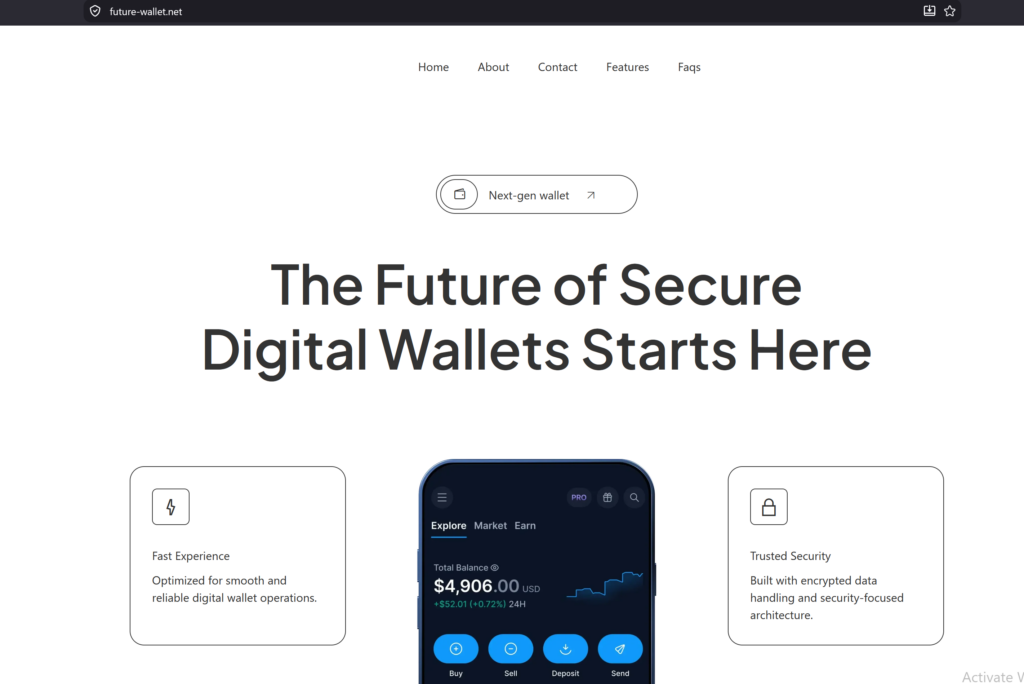
The website presents itself as a next-generation digital wallet. The supplied screenshot shows a polished interface promoting “The Future of Secure Digital Wallets”, with claims about fast wallet operations, encrypted data handling, and a mobile wallet displaying a cryptocurrency balance.
However, technical-security research identifies future-wallet.io as a serious security concern. PhishDestroy classified secure.future-wallet.io as Critical, with an 81/100 evidence score, and reported that multiple security systems had flagged the domain. Its report specifically classifies the observed activity as a crypto drainer threat. (PhishDestroy)
Cybertrace also lists future-wallet.io among websites identified as fake cryptocurrency wallet sites associated with cryptocurrency theft, phishing, or broader investment-scam networks. (Cybertrace™)
Quick Verdict: Very High Risk — avoid connecting a cryptocurrency wallet or depositing funds.
Platform Overview
Future Wallet appears to market itself as a cryptocurrency wallet rather than a traditional investment broker.
The supplied screenshot shows:
- “Next-gen wallet” branding.
- A cryptocurrency wallet interface.
- Buy, sell, deposit, and send functions.
- A displayed USD balance.
- Claims of encrypted data handling.
- A “Trusted Security” section.
- Navigation for Home, About, Contact, Features, and FAQs.
These features create the appearance of a conventional cryptocurrency wallet.
However, a professional interface does not prove that a wallet is safe. Fake wallet websites can deliberately use modern designs, realistic balances, transaction screens, security claims, and familiar cryptocurrency terminology to persuade users to connect their wallets or transfer funds. Cybertrace specifically warns that fake wallet websites often use this type of convincing presentation. (Cybertrace™)
The domain history is also concerning. WHOIS records show that future-wallet.io was created on January 20, 2026, making it a relatively new domain. The registrant information is privacy-protected, with the registration record identifying Njalla Okta LLC as the registrant organization. (Whois)
Based on the available information and common patterns of fraudulent platforms, Future Wallet, exhibits multiple characteristics of a potential scam. It is strongly advised to avoid any financial transactions with this website. If you have already invested, consider seeking legal advice and reporting the platform to relevant authorities as well as FRAUD AND FINANCIAL CRIME ADVISORS for charge back.
Reported Withdrawal
Withdrawal risk is particularly important with cryptocurrency wallets that display account balances.
Security research on future-wallet.io identifies the secure.future-wallet.io subdomain as a crypto-drainer threat. PhishDestroy reports that the domain was detected by four of 91 VirusTotal security engines and was also associated with a Spamhaus phishing listing and a URLQuery threat alert. (PhishDestroy)
This does not mean that every user necessarily lost money. However, it means that interacting with the domain can expose users to potentially serious cryptocurrency-security risks.
A common fake-wallet pattern involves showing a balance that appears valuable and then requiring the user to pay a fee, deposit cryptocurrency, connect another wallet, or complete a supposed verification process before funds can be withdrawn. Cybertrace describes this pattern in its research into fake cryptocurrency wallet networks. (Cybertrace™)
If Future Wallet asks you to deposit additional cryptocurrency before withdrawing an existing balance, do not automatically comply.
Customer Service Concerns
The screenshot provides navigation for “Contact” and “FAQs,” but this alone does not establish that a legitimate company operates the wallet.
A trustworthy cryptocurrency wallet should provide clear information about:
- The company operating the service.
- Its registered jurisdiction.
- Its development team.
- Security documentation.
- Wallet architecture.
- Privacy policy.
- Terms of service.
- Customer-support channels.
- Whether the wallet is custodial or non-custodial.
The available domain information does not establish a transparent corporate identity behind future-wallet.io. The relatively recent registration date and privacy-protected registration details add to the uncertainty. (Whois)
User Warnings
The most serious warning comes from cybersecurity research rather than ordinary customer reviews.
PhishDestroy’s August 2026 analysis classified secure.future-wallet.io as Critical, with an 81/100 evidence score. It reports that four security vendors detected the domain and that the site was associated with a crypto-drainer classification. (PhishDestroy)
Cybertrace independently lists future-wallet.io among examples of fake cryptocurrency wallet websites and warns that such sites can be connected to cryptocurrency theft, phishing, and investment-scam networks. (Cybertrace™)
The website’s use of security-focused language should therefore not be accepted as proof of security. Claims such as “Trusted Security” and “encrypted data handling” need independent technical verification.
Investment Risks Every Investor Should Understand
Wallet-drainer risk: Connecting a wallet to a malicious website can potentially expose assets to unauthorized transactions.
Private-key risk: Never enter a seed phrase or private key into an unfamiliar website.
Transaction risk: Cryptocurrency transactions can be irreversible once confirmed.
Phishing risk: A fake wallet may imitate legitimate cryptocurrency services to obtain credentials or approvals.
Balance-display risk: A number displayed on a website does not necessarily represent cryptocurrency that you can withdraw.
Domain risk: Newly created or frequently changing domains deserve additional scrutiny.
Recovery risk: Cryptocurrency stolen through an unauthorized blockchain transaction can be extremely difficult to recover.
A valid SSL certificate does not make a cryptocurrency wallet legitimate. PhishDestroy notes that future-wallet.io had a valid Let’s Encrypt certificate, while still classifying the associated subdomain as a critical threat. (PhishDestroy)
What Should You Do If You Experience Problems?
If you have already interacted with future-wallet.io, stop using the website until its safety has been independently established.
If you connected an existing wallet, review the wallet’s recent activity immediately. Where appropriate, revoke suspicious token approvals using a reputable blockchain approval-management tool.
If you entered a seed phrase or private key on the site, assume that wallet is compromised. Move remaining assets to a new, securely generated wallet rather than continuing to use the exposed credentials.
Also preserve:
- Transaction hashes.
- Wallet addresses.
- Screenshots.
- Emails and messages.
- Website URLs.
- Payment records.
- Any cryptocurrency addresses supplied by the website.
If cryptocurrency has already been stolen, report the incident to the relevant exchange, blockchain service, cybersecurity authority, and law-enforcement agency.
File a complain with STB INVESTIGATION for Charge back.
Is Your Money Truly Gone? Understanding the Reality
A failed withdrawal does not automatically mean that every lost payment is permanently unrecoverable.
Depending on how the money was transferred, there may be legitimate avenues for investigation or dispute. Card transactions, bank transfers, and cryptocurrency transactions have different recovery possibilities.
Retain all documentation, including account statements, payment confirmations, emails, and screenshots. Depending on the payment method and circumstances, your payment provider, financial regulator, or law enforcement agency may be able to advise you on available reporting or dispute procedures by STB INVESTIGATION.
Final Verdict
Is Future Wallet (future-wallet.io) legitimate?
The available evidence points to extreme caution.
The website presents a professional digital-wallet design and claims to provide secure cryptocurrency services. However, future-wallet.io was registered only in January 2026, and its ownership information is not transparently disclosed. (Whois)
More importantly, independent cybersecurity research has classified secure.future-wallet.io as a critical threat and associated it with crypto-drainer activity. (PhishDestroy) Cybertrace also lists future-wallet.io among known examples of fake cryptocurrency wallet websites associated with theft and phishing risks. (Cybertrace™)
These findings provide sufficient reason not to connect a cryptocurrency wallet, enter a seed phrase, approve transactions, or deposit funds through future-wallet.io.
Final Verdict: Avoid — Very High Risk
Note: The supplied screenshot shows future-wallet.net, not future-wallet.io. Because the domains are different, this review should not be used as proof that the .net website is operated by exactly the same entity. However, given the strong security warnings surrounding the .io domain, users should exercise extreme caution with similarly named Future Wallet domains.
If you have already invested, seeking legal and forensic assistance promptly is critical. STB Investigation offers a structured approach: forensic tracing of crypto transactions, coordination with French authorities, and negotiation with the platform (if still operational) to maximize the chance of fund recovery.
Recommendation
- For New Investors: Avoid Future Wallet (future-wallet.io) until it obtains a verifiable licence from the ASIC, AMF or another EU regulator and provides transparent, third‑party audited performance data.
- For Existing Clients: Document every transaction, capture screenshots of the platform, and consider contacting a specialized recovery firm—STB Investigation—which has experience in cross‑border financial fraud cases, especially those involving crypto‑based payouts.
Sources
- PhishDestroy — Future Wallet security analysis
- Cybertrace — Crypto Wallet Scams and Future Wallet listing
- WHOIS — future-wallet.io domain information
- WHOIS — future-wallet.net domain information
Disclaimer
The content above is for informational purposes only and does not constitute financial, legal, or investment advice. All statements are based on publicly available information and user‑submitted reviews as of August 2026.